

 English - EN
  繁體 - ZH-TW
  简体 - ZH-CN
  Español - ES
  日本語 - JA
  العربية - AR
  Русский - RU
  Français - FR
PRSE 2026 Floor Report | Europe Just Wrote Three Prescriptions — Where Does Asian Machinery Stand?
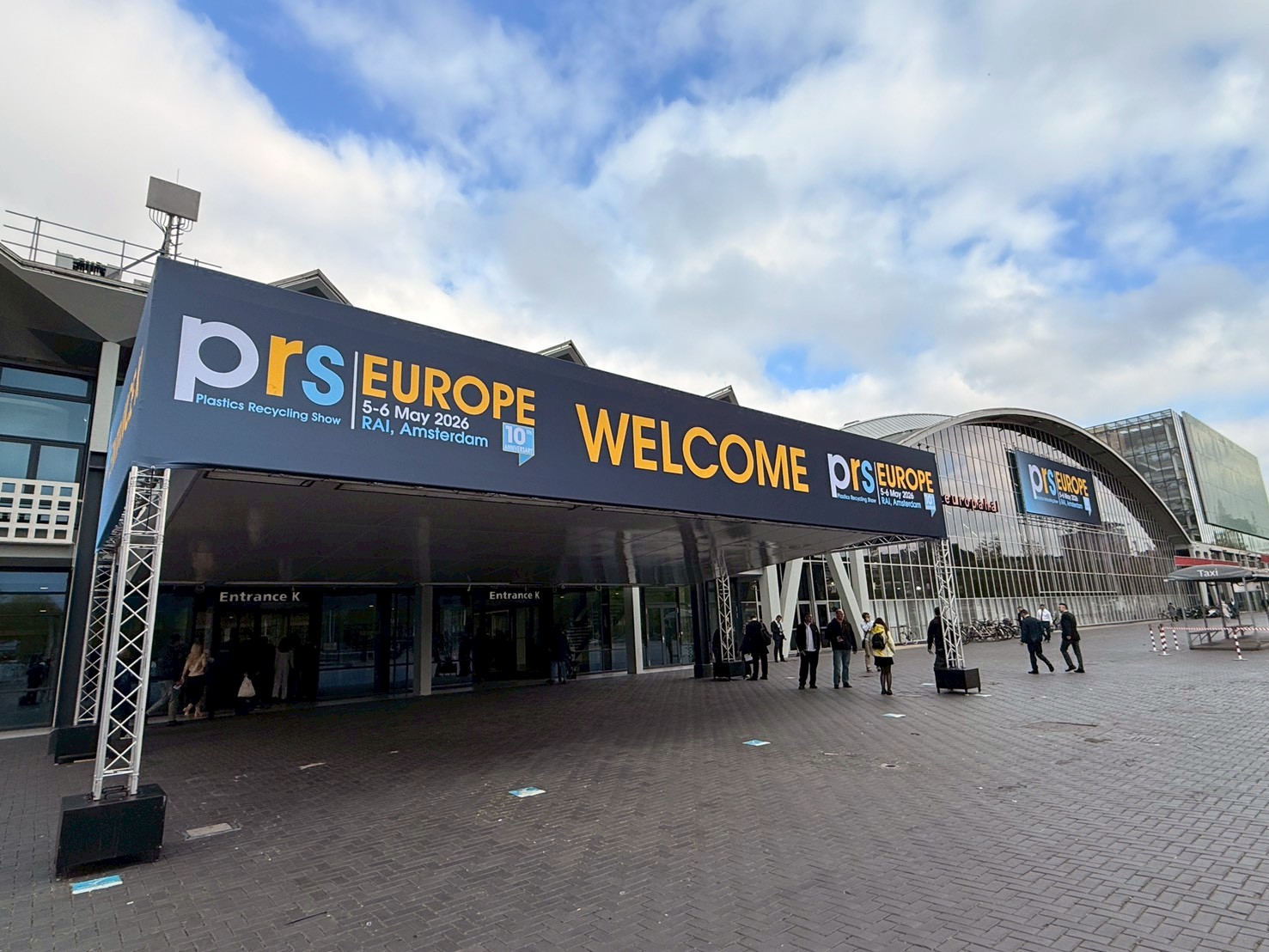
Europe's Recycling Industry Just Got a Prescription
"European plastics recycling is in intensive care."
That's not editorial framing — it's the official tone of the PRSE 2026 opening keynote. EU Environment Commissioner Jessika Roswall and Plastics Recyclers Europe President Ton Emans took the stage with a session titled From Crisis to Competitiveness: Re-Building the European Plastics Recycling Industry. Note the word "rebuilding" — the industry's own institutions are now openly acknowledging the sector needs critical care.
But after two days walking the halls, what struck me wasn't the crisis. It was watching Europe write three very specific prescriptions in real time. For Asian machinery builders, the question isn't "Europe is sick." It's "what medicine does Europe now need?"
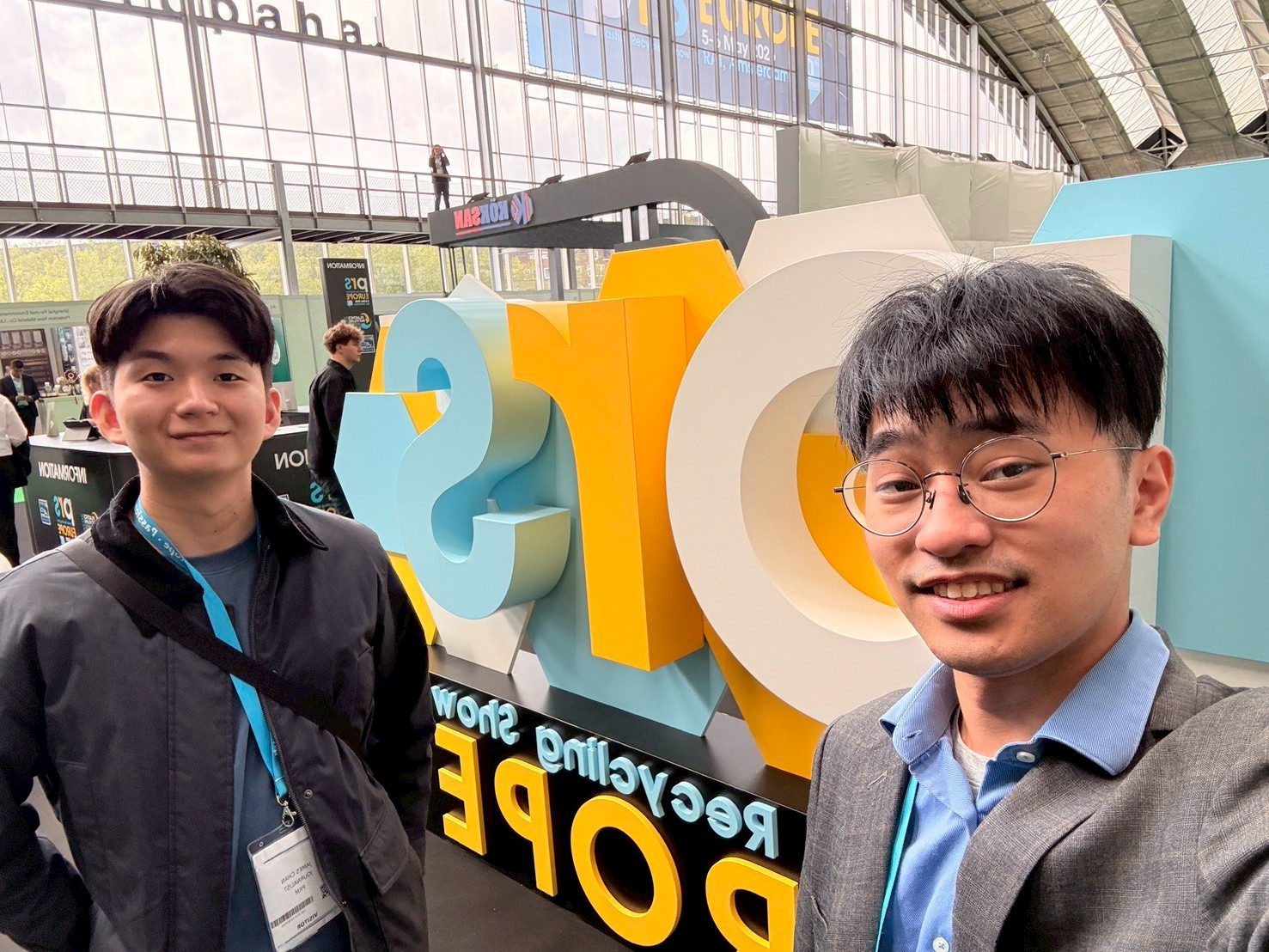
This is PRM-TAIWAN's first time at PRSE. The purpose of this floor report is simple: filter the noise from an Asian industrial perspective and tell you what's worth your attention.
Why This PRSE Matters
Start with a countdown: The EU Packaging and Packaging Waste Regulation (PPWR) becomes generally applicable on August 12, 2026 — three months after this show closed. The entire European packaging rulebook flips that day. Everyone on the floor was asking the same question: how do we survive the deadline?
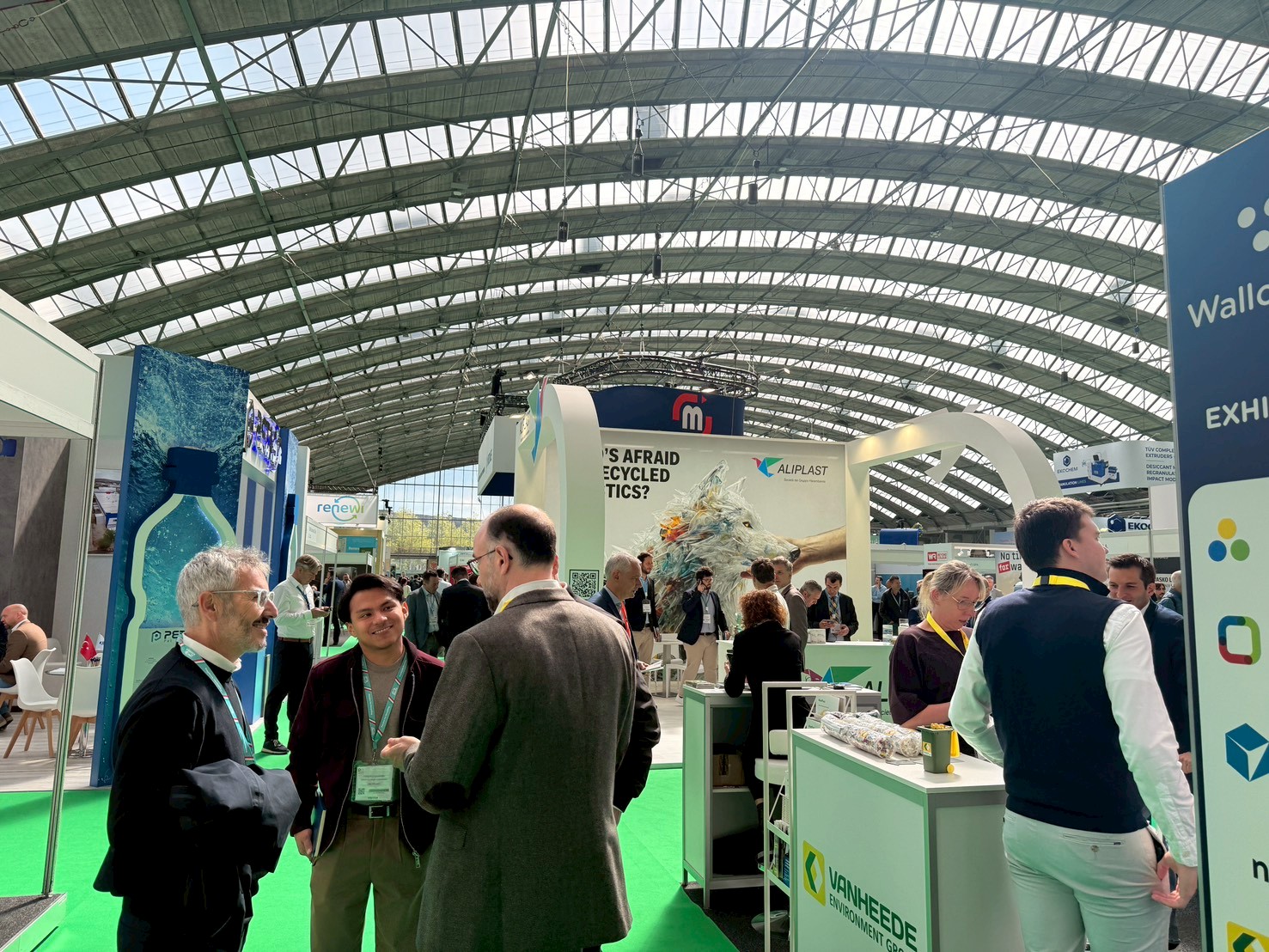
The 10th-anniversary edition broke records: 500+ exhibitors, 13,000+ professional visitors, 80+ countries. Walking in, the coordinates were clear. Petrochemical giants ExxonMobil, LyondellBasell, and Borealis all pivoting hard to circular narratives. European machinery first-tier names — EREMA, Lindner Washtech, Starlinger, KraussMaffei — all fully present. Optical-sorting leader TOMRA drew packed audiences at every session. The new AI Innovation Hub turned AI-plus-robotics sorting into a live demo — get there late and you stood.
But what filled my notebook were three sessions that crystallized where Europe is heading next. I'm calling them the three prescriptions.
Prescription No.1: Turning the Extruder From a "Black Box" Into Data-Driven Intelligence (VTT)
The session by VTT (Technical Research Centre of Finland) was my biggest aha moment of the day.
Start with the problem: recycled feedstock is permanently inconsistent. Every batch arrives with different impurities, viscosity, MFI. How do traditional extruders cope? Honestly — by veteran operators making judgment calls and gambling on output quality. That's VTT's "black box."
VTT's answer: crack the box open and stuff it with data.
● In-line rheology continuously measures viscosity and MFI
● UV-Vis spectroscopy monitors color and additives
● NIR (near-infrared) detects polymer contamination
● FTIR quantifies VOCs
These streams feed into VTT's models in real time, and the machine "self-learns." You set a target viscosity, and the system automatically calculates how much virgin resin or different-MFI recycled material to blend in. The result, in VTT's words: "virgin-like material quality."
In other words: extruders are evolving from blue-collar workers into self-adjusting engineers.
Floor echo: Dynisco pushing the same idea from another angle
This "give the recycling line a brain" concept isn't VTT's alone. Dynisco — the American melt-measurement instrumentation pioneer with 50 years of pressure sensors, MFI meters, and online rheometers — was preaching the same gospel on the floor: once EU traceability rules kick in, every batch of PCR has to prove its quality, and instruments at Dynisco's level are the only way to do that at scale.
Open up almost any extruder's pressure sensor and there's a good chance there's a Dynisco OEM under the hood. VTT advances quality through models. Dynisco quantifies quality through instruments. Two roads, same destination.
What I wrote in my notebook:
The European recycling line of the future is not "an extruder." It's "extruder + sensor + software + data model."
If Asian machinery builders keep selling hardware-only with spec sheets, your competition becomes "European players who deliver an integrated quality-assurance system." You'll still own the mid-and-low tier, but breaking into European brand-owner supply chains means getting through that wall.
At minimum: leave the sensor interfaces open. Your machines should be capable of outputting viscosity, MFI, and impurity signals. Even if you don't build the software layer yourself, your customers need a way to plug their own monitoring stack in. Otherwise you've locked yourself out of next-generation lines.
Prescription No.2: Designing Equipment to Eat Dirty Feedstock (Fimic)
Fimic took a totally different angle from VTT — but the harmony was striking.
VTT talks about stabilizing material quality. Fimic talks about stabilizing equipment behavior.
Fimic opened with a number every factory owner immediately gets: process instability can drag equipment efficiency down by up to 20%.
Why? Impurities cause pressure swings, irregular melt flow, faster gear pump wear — leading to downtime, parts replacement, and inconsistent product quality. That's the recycling industry's "hidden cost."
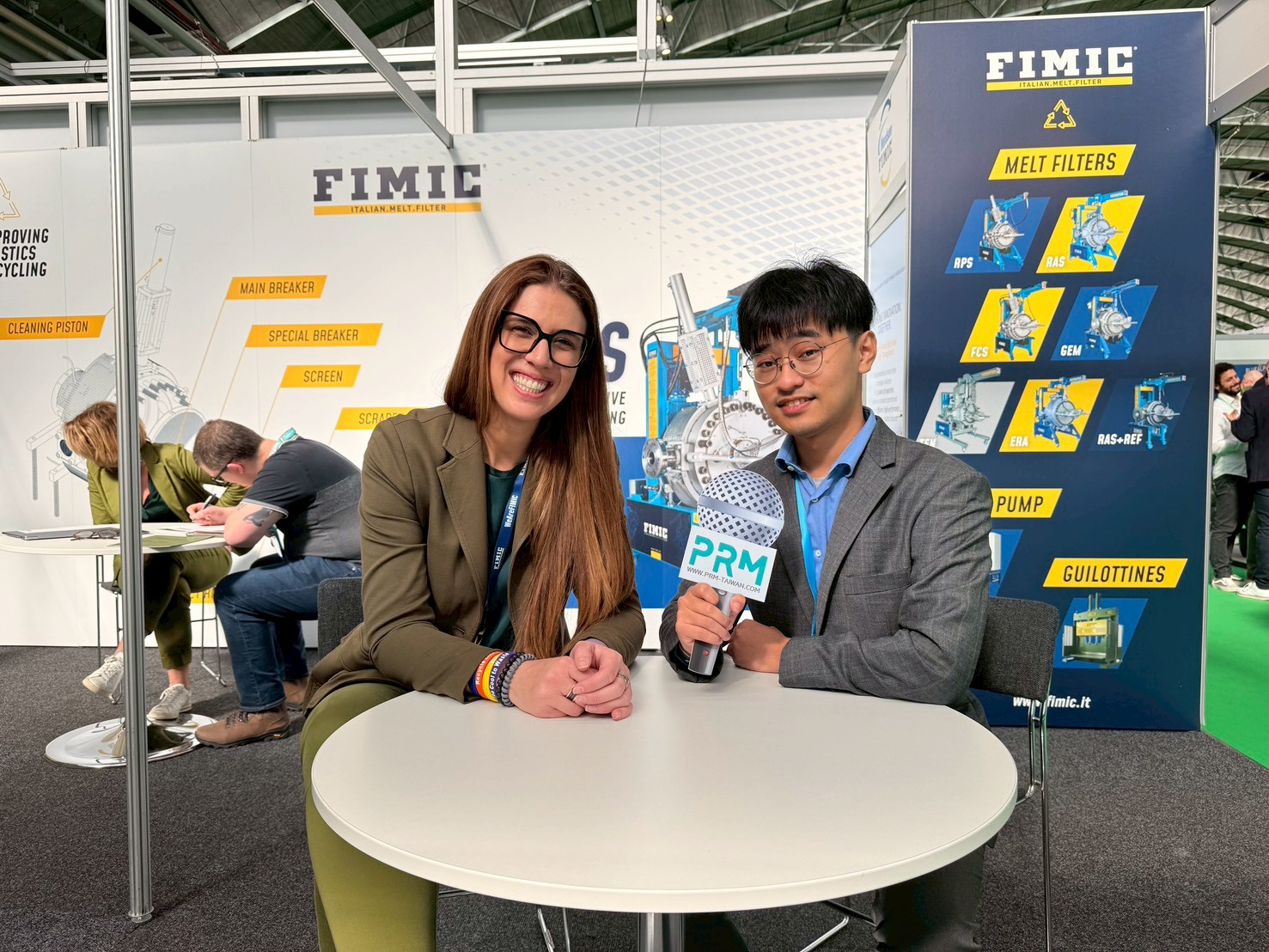
They unveiled two new melt pumps:
RMP — A Revolutionary Take on the Gear Pump
When traditional gear pumps wear out, you have to detach the entire housing from the line to swap it. Painful and expensive.
RMP uses a two-body concept: the main housing stays on the line, and operators only swap the worn internals (gears, bushings). Downtime drops dramatically; maintenance costs collapse.
Use case: production lines with a pre-filter installed.
FPP — Double Piston Pump
Designed for lines that don't have, or don't want, a pre-filter. FPP tolerates high contamination, maintenance intervals stretch up to 3 years, and throughput is impressive (1–2.5 t/h or 2.5–4 t/h depending on size).
Old-school machinery vendors said: "Give me clean feedstock." The new ones say: "I'm engineered to eat dirty feedstock."
Floor echo: Stability starts much earlier in the line
Fimic addresses what happens after feedstock enters the extruder. But line stability actually starts further upstream.
Germany's ZERMA (founded 1943, 80 years doing one thing — making plastic smaller, from 2.2 kW units to 200 kW heavy-duty crushers, all in-house) and Lindner Washtech (the European benchmark for contaminated-waste shredding-washing integration) were showing new equipment too. Why does this matter alongside Fimic? Because if particle size and wash quality at the front end aren't stable, no Fimic or VTT magic downstream can save you.
The competitive axis among European integrated-line players is now crystal clear: "How dirty can my equipment eat? How long does it run between services? Can I keep it stable?" All three matter.
If you're in recycling equipment, three questions to take home:
- Is your machine's tolerance window wide enough?
- How long are the maintenance intervals?
- Have you actually engineered against the "downtime to swap parts" pain point?
If the answers aren't strong, breaking into the European recycling market is going to be brutal.
Prescription No.3: Recycled Material Needs an "ID Card" (PPWR + DPP)
The third session was a regulatory panel — the kind of thing that sounds like a dry briefing. Five minutes in, I realized this might be the area Asian manufacturers most underestimate, and where the biggest opportunity lives.
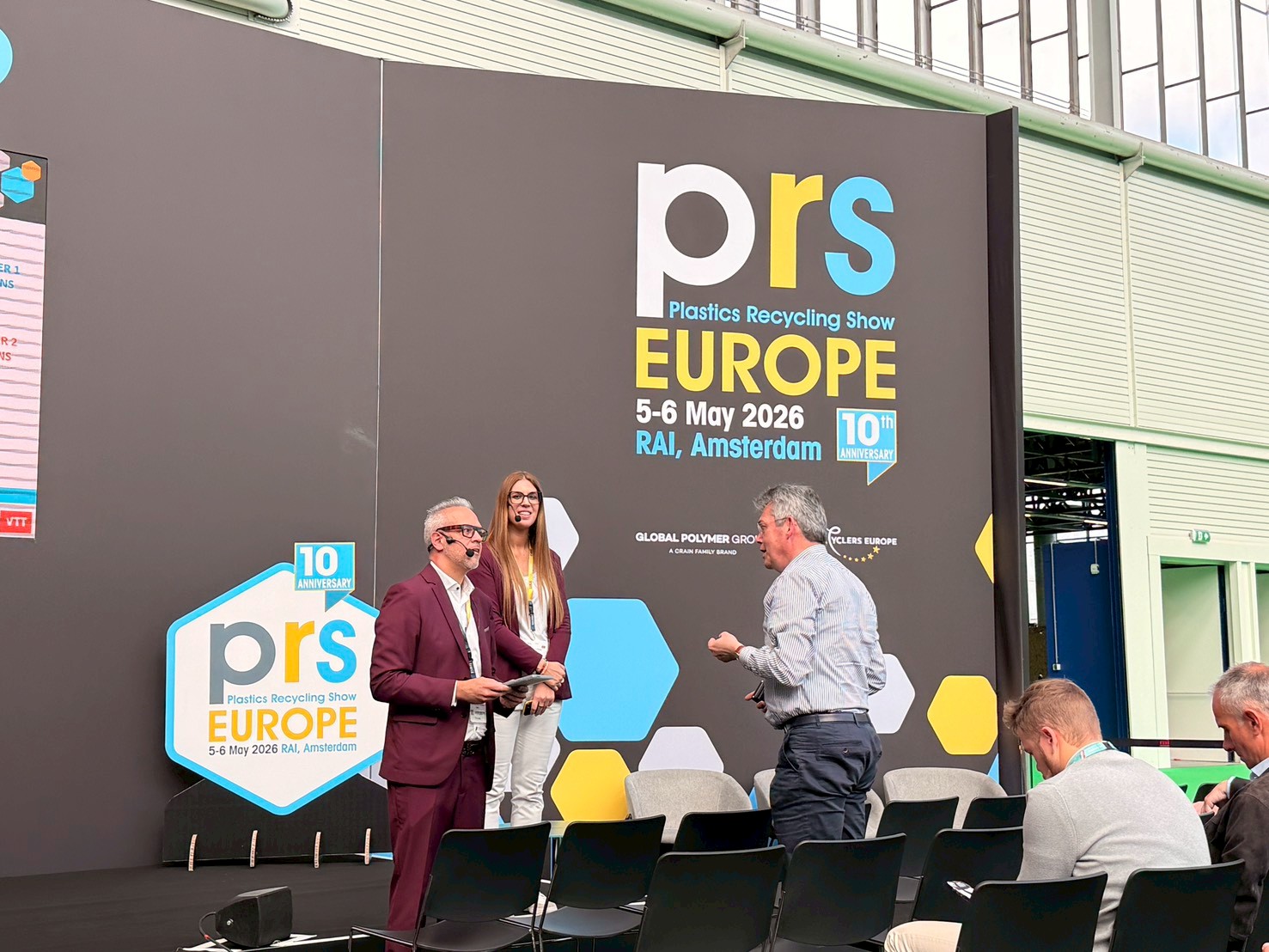
Three keywords: PPWR, DPP, EN 15343.
● PPWR — Once it applies on August 12, plastic packaging in the EU market must contain a defined percentage of recycled content, and that content must be verifiable. Sellers prove it; buyers audit it.
● DPP (Digital Product Passport) — The EU's chosen verification tool. All data feeding into a DPP — packaging history, recycled-content provenance — must be "verifiable," not vendor self-claims.
● EN 15343 / ISO 22095 / RecyClass — Three names Asian operators should start memorizing. EN 15343 governs mechanical recycling quality. ISO 22095 frames mass-balance accounting. RecyClass is the certification system. European brand owners will ask about these directly.
"Contracts alone are no longer enough. Brands will demand to know exactly where your material comes from."
Supply-chain transparency just moved from "nice to have" to "must have."
Floor echo: The brand side has already drawn the line
The buyer side at PRSE didn't dance around it. ALPLA (global packaging group, multiple sessions on rigid-packaging circular design and food-grade rPET case studies) and IKEA (recycled-polymer raw material leadership) both took the conference stage repeating the same message: our future supply chain has to be verifiable.
The show's co-organizer, Plastics Recyclers Europe, holds the policy voice for European recyclers. Right next door, RecyClass runs the European recyclability rating and design-guidance platform. Standing in front of those booths in person, one thing clicked for me: in the next few years, these two names will become unavoidable counterparts — or partners — for Asian machinery builders.
Picture a 2027 scenario:
Your customer — a European recycler — wants to sell their output into IKEA's supply chain. IKEA procurement's first question: "What's your RecyClass certification number? Where's the EN 15343 data for this batch?"
If your machinery can't generate data that plugs into this certification stack, your customer loses the deal — and your machinery loses the order.
Conversely: machinery that integrates EN 15343 / RecyClass-compatible data outputs walks straight into European brand-owner supply chains. That's the opportunity. It's also a deadline.
Bringing the Three Prescriptions Back to Asia
| Prescription | Core Solution | What Asian Machinery Builders Should Do |
| Quality Upgrade | VTT + Dynisco | Keep sensor interfaces open; output viscosity / MFI / impurity data |
| Process Stability | Fimic + ZERMA / Lindner | Re-examine tolerance windows, service intervals, dirty-feed adaptability |
| Market Trust | PPWR + DPP + EN 15343 | Learn the European certification language; plan material-provenance modules |
These are not future tense. They are present tense. PPWR applies August 12. The clock is short.
The good news: at PRSE 2026, more than one Asian player is already moving in this direction.
Three Ways Asia Showed Up at PRSE 2026
1. Genius Machinery
— The Only Taiwanese Recycling-Equipment Maker on the PRSE Floor
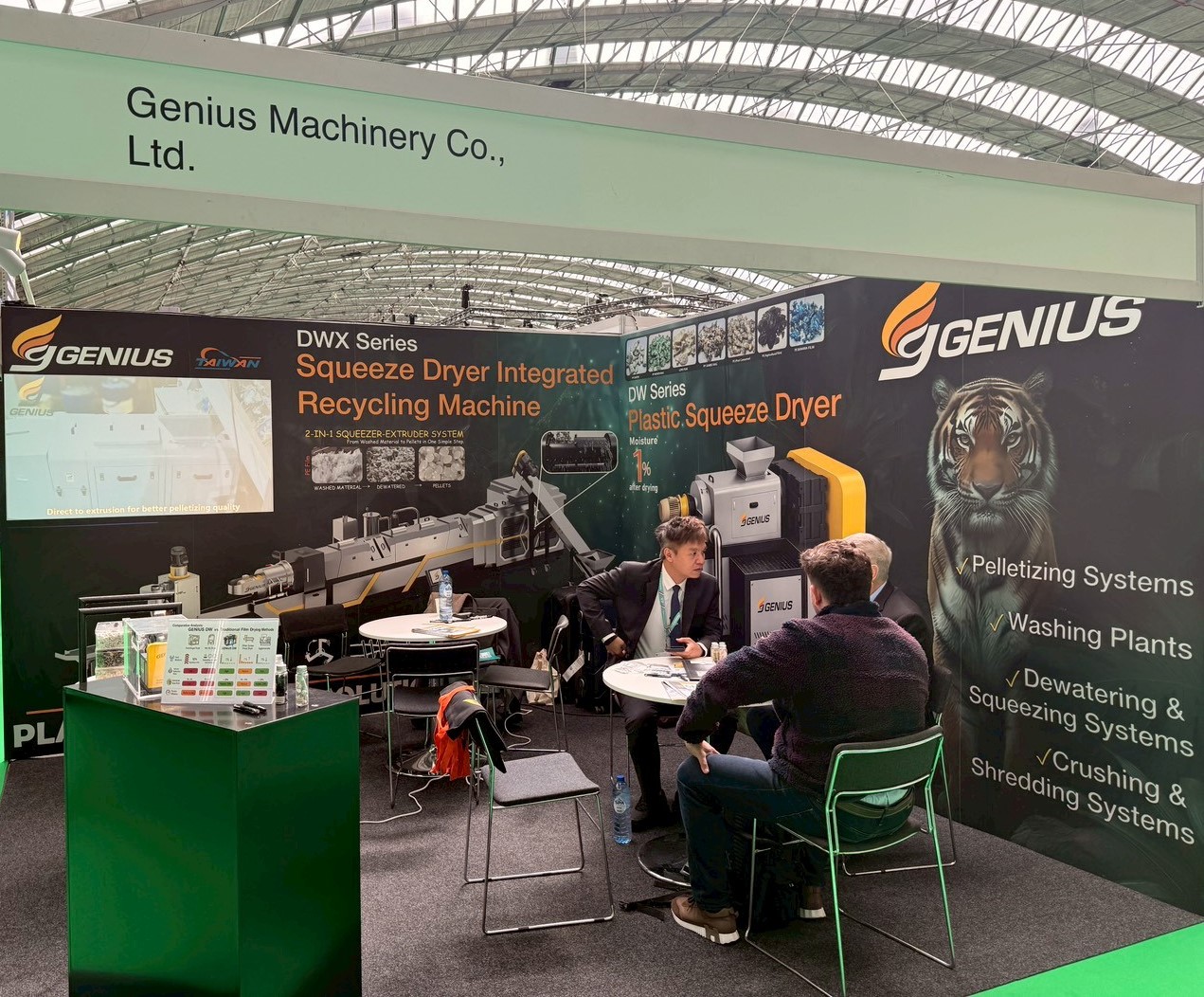
This fact alone is worth a pause. The 10th edition of PRSE — 500+ exhibitors, 80+ countries of buyers walking the halls — and from Taiwan's recycling-equipment industry, there was just one face on the floor: Genius Machinery.
Why them?
The answer starts with a small but expensive problem Europe is wrestling with right now.
"Wet film" is currently burning through European recyclers' P&L.
Agricultural film, post-consumer shopping bags — these come out of the wash line at 30%–50% moisture content. The traditional fix is thermal drying. In an era of skyrocketing European energy prices, that's literally burning money.
Genius Machinery's signature Squeeze Dryer does it differently: mechanical force pushes the water out — no heat, no electricity bill, moisture pressed below 3%, sometimes as low as 1%. An entire energy-hungry stage gets removed from the line.
This maps cleanly onto Europe's two dominant priorities right now:
● Energy savings — replace the dryer (an electricity hog) and the math is obvious to any European CFO with a spreadsheet
● Decarbonization — processing energy is a major chunk of any PCR carbon-footprint calculation; mechanical dewatering produces an order of magnitude less CO₂ than thermal drying
That's why a pattern keeps repeating across recycling plants in Europe, Japan, and South America: the integrated line might be German or Italian, but the dewatering stage — that's often Taiwanese. In Japan alone, Genius shipped 15 units in 2019. Japanese buyers' standards rival the Germans' for pickiness. That number is its own credential.
This year on the floor, the DWX Series takes things further — integrating dewatering and pelletizing into a single line, with payback under 18 months. What it really solves is the same feedstock variability VTT and Fimic are attacking from their own angles: stabilize moisture, and downstream extrusion variation drops a level.
Founded in Taichung, nearly 50 years in. Showing up at RAI Amsterdam at this exact moment — they're standing in the right spot.
Quote of the trip: "The integrated line might be German, but the dewatering stage — that's often Taiwanese."
2. BoReTech (Zhejiang) — PET Full-Line Plant Export
Founded in Taiwan in 1991, set up in Zhejiang in 2005 to manufacture equipment, with Zhongding Engineering joining as a shareholder in 2017 to sharpen engineering capability further.
What sets the group apart: they sell equipment AND use their own equipment. Their group runs Anshun Chemical Fiber and BoReTech Resource Recycling — actually operating the lines they sell. Globally, they've shipped 300+ PET bottle washing systems, with 5.8 million tonnes of PET bottles regenerated through their equipment annually. Their playbook is "full plant + value pricing + localization," meeting EREMA and Starlinger head-on in emerging markets.
3. Horng En Group — General-Purpose Recycled Materials
Founded in 1980. 44 years of doing rPE / rPP / rABS / rPS / rPC. O'right's zero-carbon shampoo bottles? That's Horng En's material. Their ocean-plastic recycling certification is a real edge when international brands hunt for "PCR with a story." The founding story (three brothers building a Taiwanese recycled-plastics leader on a NT$1M loan from their father) plays well in European markets where provenance narratives sell.
Three companies, three business models: niche champion, full-plant exporter, story-driven materials.
Asian machinery and material suppliers used to get framed in Europe as "the cheaper alternative." PRSE 2026 made it clear: that frame is now outdated. Asia's differentiation in the European market spans the full spectrum — these three companies just laid out the whole range.

メディアパートナー