


 English - EN
  繁體 - ZH-TW
  简体 - ZH-CN
  Español - ES
  日本語 - JA
  العربية - AR
  Русский - RU
  Français - FR
Breathable, Yet a Liquid Barrier: What to Know Before Evaluating a PE Breathable Film Line
The formula sets the potential. Process stability decides whether every batch gets there.
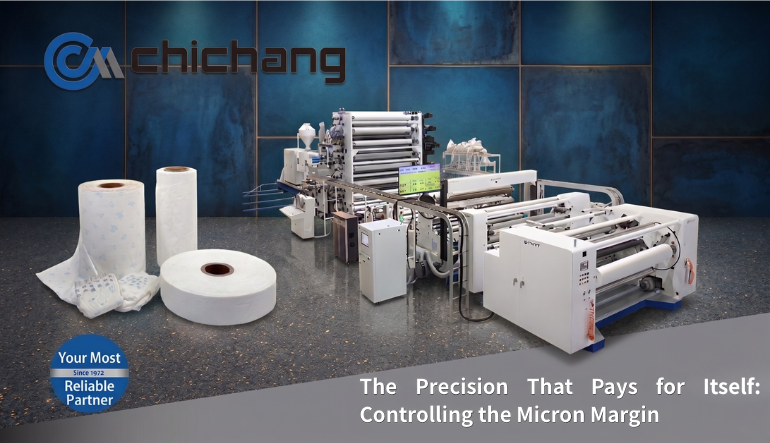
Breathable, Yet a Liquid Barrier: What to Know Before Evaluating a PE Breathable Film Line
PE breathable film is a polyethylene film with micron-scale pores throughout: water vapor passes through, while liquid water is held back under the designed pressure conditions. In baby diapers and sanitary napkins, it typically serves as the backsheet — a liquid-barrier outer layer that can still release moisture vapor, thanks to its microporous structure. Chi Chang’s listed applications also include masks and surgical gowns; actual use depends on the product’s construction and regulatory requirements.
The product’s requirements pull against each other. The pore structure must deliver the target breathability — usually measured as WVTR/MVTR — yet an uncontrolled pore structure raises the risk of failing liquid-barrier requirements. The film must be thin to save material, yet thinness without uniformity costs strength and opacity. To a brand owner these are numbers on a spec sheet. To the production floor, they are a balance that has to be reproduced batch after batch.
Why is breathable film harder to run stably than ordinary PE film?
The industry’s established route is to compound PE with mineral filler, extrude it into film, then stretch it — creating interconnected microvoids through interfacial debonding between polymer and filler during stretching. That is where breathability comes from. The principle is no secret; the difficulty is reproducing it. Many variables shape the pore structure: the formulation and filler dispersion, stretch ratio and temperature, and the melt and thickness uniformity of the extrusion stage. The extrusion stage is where everything starts, and three things matter most:
· Thickness uniformity: Wherever the extruded film runs thick or thin, stretching produces inconsistent voids, and breathability and barrier performance can vary widely across a single roll.
· Basis weight stability: Backsheet basis weight is usually one of the key acceptance criteria, alongside WVTR, liquid barrier, mechanical properties, and appearance. Thickness drift means either extra resin cost above spec, or the risk of downgrading and rejection below it.
· Batch-to-batch consistency: Hygiene and medical brands audit their suppliers hard. What they buy is not “this batch turned out well” but “every batch is the same.” The more a line leans on individual operator feel, the harder that variation is to suppress.
Competitiveness is not only in the formula, it is in whether the line can stably reproduce the pore structure the formula was designed for.
Which part does Chi Chang’s automatic line address?
Some background first: founded in Tainan in 1972, Chi Chang has kept film and sheet extrusion at the center of its work for over five decades, exporting complete lines since 1980 to the UK, Russia, Australia, Japan, Canada, and the United States. Cast PE (CPE) breathable film equipment is one of its long-standing product lines.
The current Automatic Cast PE Breathable Film Line addresses precisely the extrusion stage and thickness control described above:
· Melt distribution: A 2.7-meter automatic T-die from Cloeren (USA), a benchmark name in extrusion dies and feedblocks. The automatic die is designed to improve melt distribution uniformity across the full width.
· On-line thickness gauging:An automatic thickness gauging system from NDC (USA) continuously measures thickness on-line, helping operators identify deviations early instead of discovering an out-of-spec roll only after it comes off the line.
· Full automation: The line is built around automation and simple operation, reducing the steps that require repeated manual adjustment and helping to lower operator-to-operator variation.
· Optional surface finishing: An optional deep embossing unit covers hygiene customers’ differing requirements for hand feel and appearance.
The stretching stage and the complete line configuration are matters for case-by-case discussion against your target product specs — which is exactly what the next section covers: what to have ready before an inquiry.
Prepare these specs before you inquire
When evaluating a breathable film line, “what’s the output?” is not enough. Sorting out the following conditions first makes the discussion far more productive:
· Target WVTR / moisture vapor transmission range, and liquid-barrier requirements (e.g. hydrostatic head)
· Target basis weight and thickness range
· Finished film width and slitting requirements
· Intended resin and filler system (if a formulation already exists)
· MD/CD mechanical property requirements
· Surface requirements: embossing, hand feel, appearance
· End application and downstream customer qualification requirements (certification thresholds differ widely between hygiene and medical materials)
Demand for hygiene and medical materials is persistent, but regions, product categories, and customer qualification thresholds vary widely. Working through the list above will shorten your evaluation far more than comparing spec sheets first.
FAQ
What information should I prepare before inquiring about a breathable film line?
At minimum: target WVTR and liquid-barrier requirements, basis weight and thickness range, film width, resin/filler system, mechanical property requirements, embossing and appearance needs, and the end application. The more complete the information, the more precise the line-configuration discussion.
Can an existing formulation transfer directly to a new line?
Formulation-to-equipment matching needs case-by-case evaluation — filler type, dispersion, and stretching conditions all affect pore formation. Bring the formulation into the discussion at the evaluation stage.
How are units like embossing and thickness gauging configured?
According to the target product’s requirements. Chi Chang’s breathable film line is built around full automation, with deep embossing as an option; the engineering team recommends the specific configuration based on your spec conditions.
Evaluating a move into breathable film, or struggling to run it stably? Send the target specs from the list above to Chi Chang’s engineering team and work through a feasible line configuration, backed by five decades of film extrusion experience!
This market insight was co-piloted by AI and strictly curated by the PRM editorial team to ensure accuracy and high-value intelligence for our global buyers.


メディアパートナー